Guerrilla Warfare
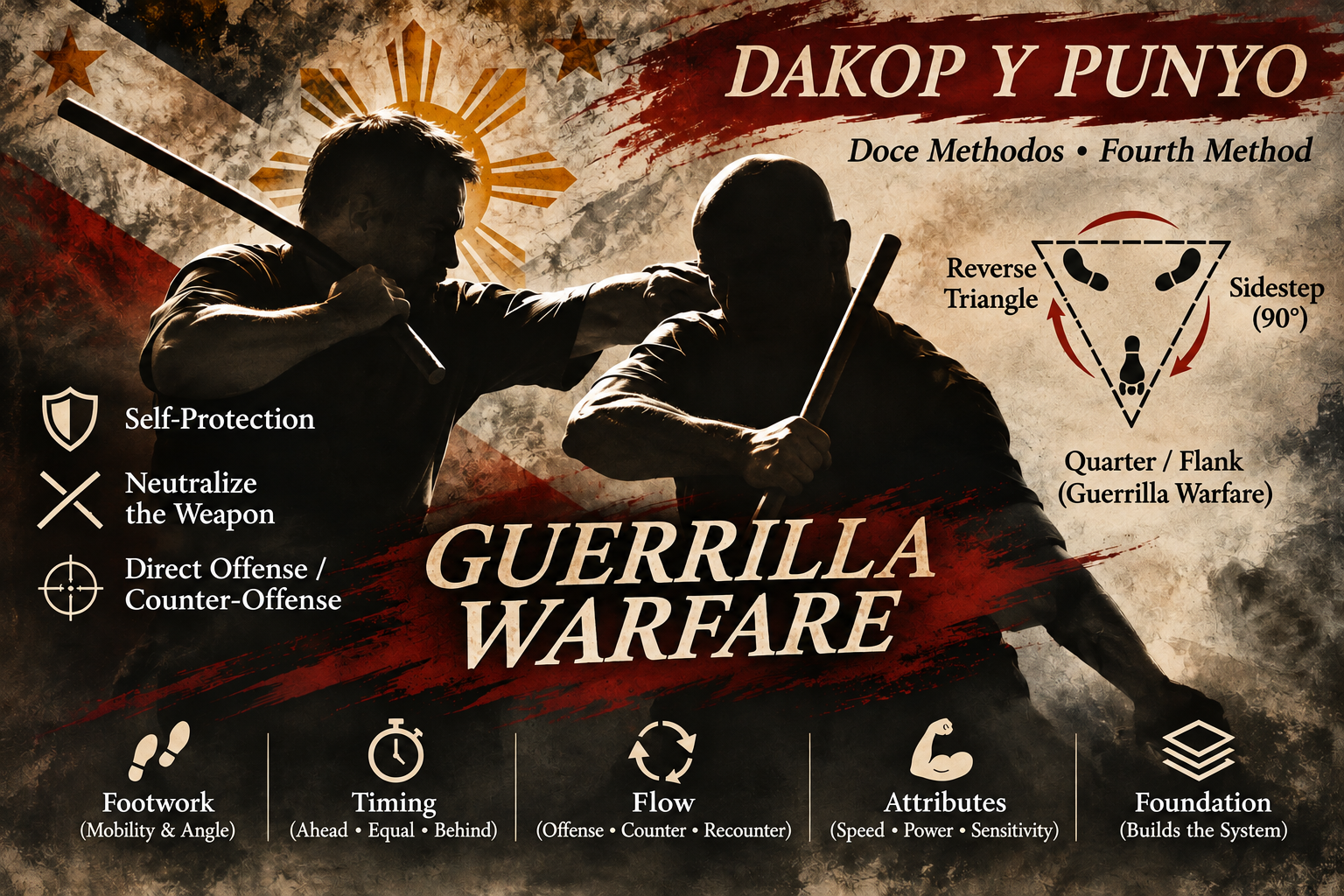
Quarter and punyo – this basic statement represents a defining strategy of the fourth method of PTK’s Doce Methodos. The Doce Methodos represents a logical progression in the development of the kali practitioner’s attributes, skills, and understanding of single edged/impact weapon combat. Dakop y Punyo is one of the first drills that directly teaches and incorporates a tactical understanding of the reverse triangle and sidestepping footwork to accomplish the combative strategy of the Method, which is practical infighting, counter-for-counter, and tap and punyo; this basic strategy of quartering or flanking at close range is guerrilla warfare, not frontal assault. Furthermore, Dakop y Punyo is also a multi-faceted drill that ultimately develops many skills and attributes that are necessary, fundamental, and foundational to the rest of the system.
Difficult But Worthwhile
Dakup Y Punyo is one of the most difficult drills to learn out of the system. Once it is learned, it becomes easier to learn the other flow drills. Dakup Y Punyo requires combined, coordinated skills and attributes that are still being learned and refined; at the same time it requires the learning, acquisition, and development of new skills and attributes. All of the combative attributes (speed, timing, power, and sensitivity) are necessary for the perfection of this drill. However, the difficulty of the drill should not be discouraging. Quality instruction and training are all that is needed. Combine this with other motivated practitioners who want to learn and develop this drill and it won’t be that difficult at all.
Intuitive Response
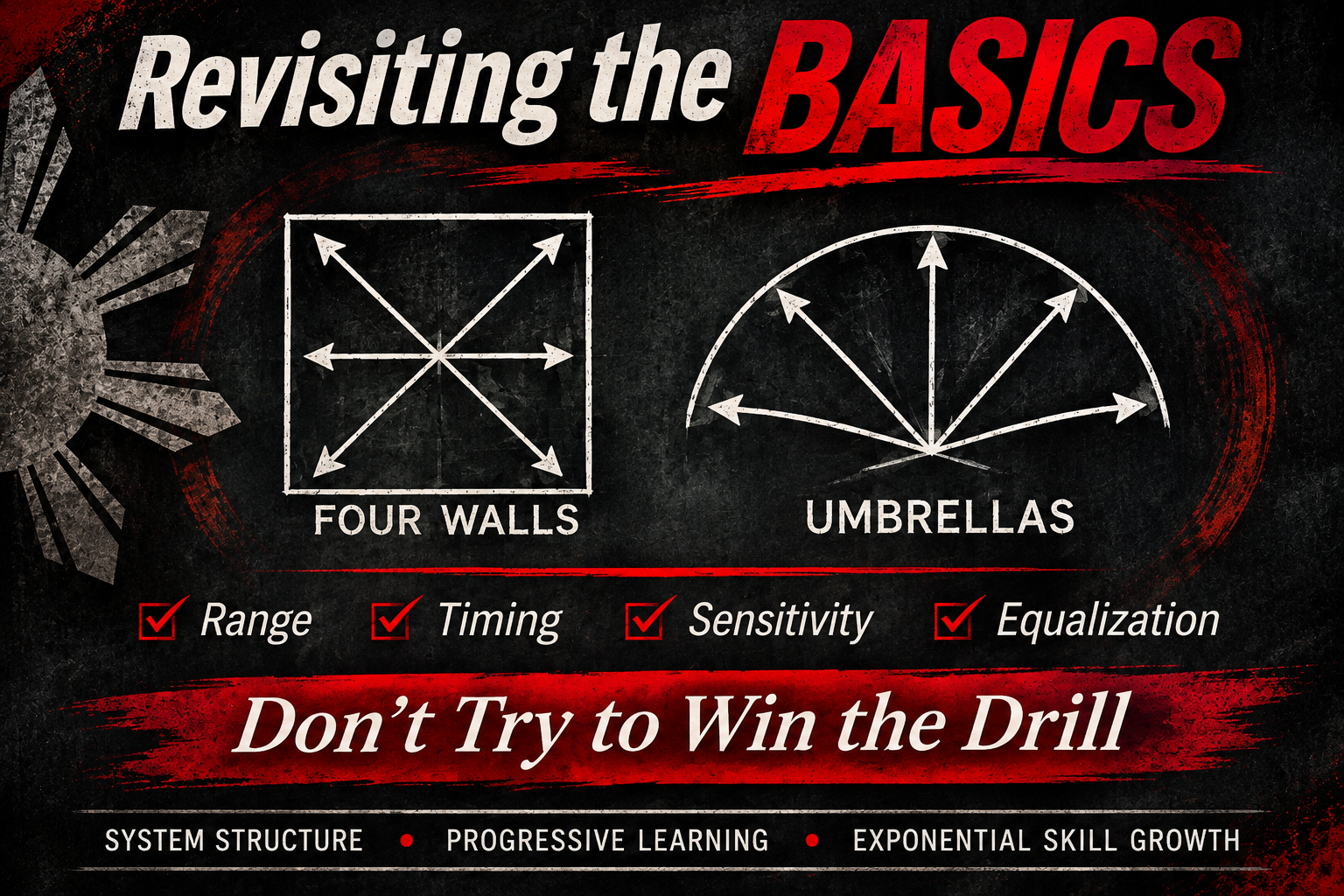
Dakop y Punyo is a combat drill, which are “two-man structured patterns of offense and counter-offense.”(Waid) As such, it develops timing, counter-for-counter skills, and the combat flow. The flow is “the intuitive tactical execution of offense, counter-offense, and recounter-offense.”(Waid) It is the first method of the Doce Methodos that trains the fighter’s intuitive responses with changes in timing from offense to counter-offense in a combat situation. The drill can be thought of as a synthesis of parts of the foundational footwork and the first three methods. Prerequisite skills developed from the previous Methods assumed by the drill include 12 Attacks, Four Walls, and Umbrellas. A more thorough and complete understanding of the Fourth Method depends on having learned and understood the previous methods. The progression is logical as each method builds upon what was learned from the previous method. In Dakop y Punyo, you “learn to forget.” (Gaje)
Combat tactical applications should be self-protective, address the opponent’s weapon, include a direct offense or counter-offensive strike and the correct range and timing. Training Dakop y Punyo will develop range sensitivity, awareness of timing, and proprioception. Simultaneously, the fighter will be learning and unconsciously encoding the principles of self-protection, neutralization of the opponent’s weapon, and the execution of direct offense or counter-offense.
You Have to Move
If you know how to move, you can control range and timing. Well-trained footwork provides the fighter with mobility, tactical options, and the means to dominate any combat situation. The footwork skills developed within the context of Dakop y Punyo allows the fighter to effectively move, attack using the forehand and backhand punyo, and counter and quarter an opponent at close-range on the reverse triangle and with the sidestep. Opponents are quartered within a triangle placing the fighter in an advantageous close-quarters position. This can be accomplished offensively or counter-offensively. This principle can be explained by analyzing segments of the drill. For example, the drill begins with a linear thrust that is countered by stepping 45 degrees right on the reverse triangle, with a left 90 degree sidestep, while executing a low umbrella across the midsection. This effectively quarters the opponent at close range, takes their center line, and places the fighter in an excellent position to deliver a backhand horizontal punyo. If executed correctly and with perfected timing, this should not be countered. However, the counter to the above thrust counter (second half of the drill) demonstrates and reinforces the principle of quartering at close range. To counter the above you execute a 90 degree sidestep to the left, dakop the backhand punyo of the opponent, and deliver a forehand punyo to Abecedario target number two. This keeps the fighter in the best position to maintain the close-quarter advantage – a paradigm example of practical in-fighting.
Strategic footwork skills developed in this drill transcend the drill itself. Footwork attributes developed in this drill become a part of the fighter executable in various combat situations. These footwork skills will get used in other combat drills and the combat flow. Practiced with explosive broken footwork, the potential for getting ahead in timing and maintaining the close-quarter advantage is greatly increased. So, the other counterpart to the footwork skills development is timing. Ahead, equal, or behind are the only possibilities with timing. Some PTK drills begin in equal timing, such as various five attacks drills, in order to develop self-protection, stick sensitivity, and offensa-offensa skills (contact skills of the Doce Methodos – forehand to forehand and backhand to backhand strikes). The timing attributes and skills developed in Dakop y Punyo provide a solid foundation for the practitioner to progress through the rest of the Doce Methodos and continue to develop and perfect these attributes. Common points of reference can be found in Dakop y Punyo and throughout the rest of the system and this is why it provides a solid foundation; it also further establishes that the Doce Methodos progresses logically and that Dakop y Punyo is a multi-faceted drill that develops a fighter’s attributes and skills in ways that transcend the drill.
Be On Time
In order to develop counter-for-counter skills and an accurate understanding of offense and counter-offense, it is imperative that Dakop y Punyo be practiced with the correct timing. This is a point that Tuhon Waid has always stressed. Combat drills are intended to build specific attributes and their correct execution is a must. Correct execution of Dakop y Punyo and other combat drills requires an understanding of the timing of the drill, offense and counter-offense, and discipline. Practice the drill in real time. Counter-offense is to be behind in timing, so if the fighter were on the receiving end of the forehand punyo it would not make sense to execute the four-wall prior to the execution of the forehand punyo by the opponent. Practicing this way does not benefit either practitioner. Developing speed, power, and precision while executing self-protective measures through the application of Four Walls requires training to be behind in timing. This does not mean always being counter-offensive. It is better to stay on the offensive. A thorough understanding of all aspects of timing requires this. Combat drills develop this ability. Besides, it will greatly enhance your ocular sensitivity and reflexes, which are used in other combat drills and improve your offensive abilities. Execution of the combat drill in real time requires focusing on the present moment, staying aware, and this requires self-control, discipline, and control of the weapon, all key ingredients to mastering the drill and the art.
Simple and Complex
Dakop y Punyo is at once simple (basic) and complex (advanced). It is a foundational drill that plays a significant role in jumpstarting the PTK practitioner’s skill set.
by Dustin Denson